
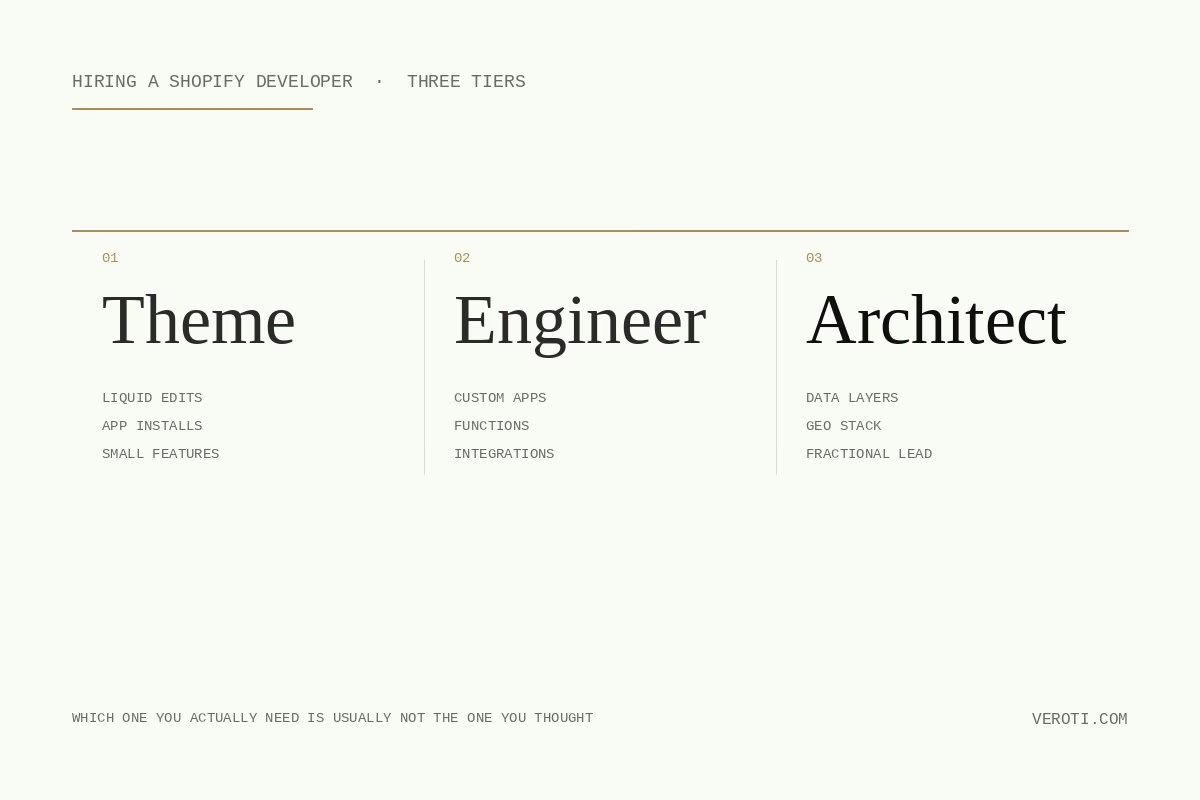
“Shopify developer” is a job title hiding three completely different jobs.
The brands that hire the wrong tier for their actual problem spend three months and a chunk of budget discovering the mismatch. The fix is usually not the developer. It’s scoping the right tier at the outset.
This piece names the three tiers, what each solves, what each costs, the most common hiring mistake at each tier, and a free three-question diagnostic for figuring out which one your store actually needs.
The three tiers
Most brands talk about “Shopify developers” like there’s one role. There isn’t. There are three, and they barely overlap.
Tier 1 — Theme developer
What they do. Liquid edits, theme customization, Online Store 2.0 sections and blocks, app installs and configuration, small features, design implementation, basic SEO clean-up. The visible storefront layer.
What they don’t do. Custom apps. Shopify Functions. Checkout extensibility beyond UI tweaks. Headless storefronts. Integrations beyond what an app already handles. Architectural decisions about how systems should fit together.
Who hires them. Brands launching, brands with a contained design or content change, brands who installed an app that needs minor configuration, brands whose problem is a specific visible thing on the storefront.
Rates. Typically $50 to $150 per hour, or $1,500 to $10,000 per project.
Common mistake. Hiring tier 1 for what is actually a tier 2 or tier 3 problem. The theme developer does their best, ships something that looks right on the surface, and three months later the actual problem (custom checkout, data inconsistency, integration drift) is still there. Not the developer’s fault.
Tier 2 — Platform engineer
What they do. Custom Shopify apps on Remix or Node, Shopify Functions (discount, delivery, payment, validation), checkout UI extensions and Pre/Post-Purchase extensions, Hydrogen and other headless storefronts, custom integrations with ERPs, 3PLs, CDPs, ESPs, custom webhook reliability work, performance work that requires touching code beyond the theme.
What they don’t do. System-level architecture across multiple apps and data sources. Roadmap. Vendor selection. Hiring decisions. Cross-team technical leadership. The decisions about what should be built, in what order, and how the pieces fit together.
Who hires them. Brands with a contained but custom problem: a subscription flow that no app does right, a B2B portal that needs custom logic, a headless storefront for the homepage, an integration with NetSuite that doesn’t exist as a packaged app.
Rates. Usually $125 to $250 per hour, or $15,000 to $80,000 per project.
Common mistake. Hiring tier 2 with no architectural oversight. The engineer ships excellent custom code that doesn’t fit cleanly into the rest of the stack, creates new contracts with the rest of the system that nobody documented, and becomes the next maintenance burden when they move on. The code is fine. The architecture around it isn’t.
Tier 3 — Architect / fractional tech lead
What they do. System design across all five layers (Product Intelligence Layer in metafields and metaobjects, structured data, AI policy contract, crawl guidance, feed logic). Roadmap. Vendor and platform selection. Code review for the engineers. Cross-app contracts that prevent drift. Hiring decisions for internal team. Audits with prioritized remediation. Fractional Director of Ecommerce Technology engagements.
What they don’t do. Type the bulk of the production code. That’s tier 2 (or your internal team) executing on the architecture decisions tier 3 makes.
Who hires them. Brands where the catalog is drifting and nobody can say why. Brands that are invisible to AI surfaces but can’t diagnose which signal is the leak. Brands whose store keeps fighting itself on promo days. Brands that have outgrown their first agency and don’t know what to hire next. Brands considering a replatform or a migration. Brands where the technical decisions are now too consequential for an in-house team without senior leadership to make alone.
Rates. Typically priced as fixed-scope audits from $7,500, project work from $25,000, or fractional engagements from $8,500 per month for one to two days a week. (For details, see engagement models.)
Common mistake. Hiring tier 3 too early. If your store is genuinely a tier 1 problem, an architect will tell you so on the intro call. Don’t pay tier 3 rates for tier 1 work.
The free three-question diagnostic
Answer honestly. Yes to one of these points you at one tier.
- Tier 1. Can you describe the problem as “change X on the storefront,” “install Y app and configure it,” or “add Z section to the PDP”? Yes → theme developer.
- Tier 2. Is the problem a contained system that needs custom code your existing apps don’t handle (subscription logic an app gets wrong, custom checkout flow, integration with a backend system, a headless front end for one part of the site)? Yes → platform engineer.
- Tier 3. Do multiple systems disagree about your products (PDP says one thing, feed says another, schema says a third)? Is your store invisible to ChatGPT, Claude, Perplexity, or Google AI Mode despite reasonable traffic? Is your catalog drifting and nobody owns the source of truth? Has scaling broken your data? Does no single person hold the technical roadmap in their head? Yes → architect.
If you answered yes to tier 3 and one of the earlier tiers, the architect goes first. The architect’s job is to scope the engineer or theme work correctly. Reversing the order is the most common mistake.
If you answered yes to none, the work might not be ready yet. Sometimes the right next step is figuring out what the problem actually is before hiring anyone. (For a structural read on the AI-surface side specifically, see Generative Engine Optimization for Shopify: the five-layer stack, which includes a five-question diagnostic for the architectural layer.)
How to tell tiers apart in a hiring conversation
The three tiers don’t advertise themselves clearly. Most independent developers describe themselves as “Shopify developer” or “Shopify Plus expert” regardless of where they actually sit. A few practical filters that surface the difference quickly:
- Ask what they wouldn’t touch. A tier 1 will not have an opinion on Shopify Functions architecture. A tier 2 will not have an opinion on whether your Product Intelligence Layer is structurally sound. A tier 3 will turn down a theme tweak. The boundary they enforce tells you where they actually are.
- Ask about their last six engagements. The shape of the recent work is the cleanest signal. Tier 1 portfolios are full of themes shipped and small features. Tier 2 portfolios show custom apps and integrations. Tier 3 portfolios are mostly invisible (NDA work) and described as “helped them rebuild the catalog data layer” or “ran the platform migration” rather than “built a theme.”
- Ask how they price. Tier 1 will usually quote hourly or per project. Tier 2 will quote per project, sometimes per sprint. Tier 3 will quote fixed-scope audits, fractional retainers, or per-engagement. The pricing shape mirrors the tier.
- Ask what success looks like at month three. Tier 1 will describe ships. Tier 2 will describe a system in production. Tier 3 will describe an outcome on a business metric, with the technical work as the means.
The Shopify Experts marketplace and where each tier actually lives
The Shopify Experts marketplace skews heavily tier 1 with some tier 2. It’s a reasonable place to source theme customization and contained app development. Filter aggressively by reviews, completed projects, and Plus experience for tier 2 work.
For tier 3 architecture work, the marketplace is generally not where the right people are. Architects tend to be independent, referred by other architects or by senior operators inside brands, and rarely listed on marketplaces. The search pattern that works for tier 3 is asking three people you trust who they hire when they hit a problem they can’t scope.
The other mistake: hiring an agency when you need an architect
A common pattern in $5M to $20M Shopify brands: the brand hires a mid-sized Shopify agency to “handle ecommerce technology.” The agency parses every request into tier 1 or tier 2 work because that’s what their team is structured to deliver. The architectural problems get re-shaped into theme problems or integration problems and partially solved at the wrong tier. Six months later, the data is still drifting, the AI surfaces still don’t recommend the brand, the store still fights itself on launch days, and the agency is producing tickets faster than the underlying problems get smaller.
Agencies are not the problem. The wrong tier is the problem. A common working pattern that produces good outcomes: an architect (tier 3) owns the design, decisions, and roadmap; the agency executes the tier 1 and tier 2 work the architect scopes. The architect is the buffer between the business and the build team, translating business problems into well-scoped technical work and pushing back on requests that look technical but aren’t.
When you need none of the above (yet)
Sometimes the right answer is to not hire a developer at all.
If your problem is “sales are flat,” that is almost never a developer problem. It is a marketing problem, a product problem, a positioning problem, or a category problem. Hiring a developer for it produces a refactor of the wrong thing and the sales stay flat.
If your problem is “the team is confused about what to build,” that’s a roadmap problem, not a developer problem. A short engagement with someone who can audit and prioritize (which is tier 3 work, but scoped as a one-off counsel session, not an ongoing engagement) often resolves it for a fraction of the cost of a developer who would have built whatever the team guessed at next.
If your problem is “our site is too slow,” that’s sometimes a tier 1 or tier 2 problem (theme bloat, app sprawl, third-party tag governance) and sometimes a tier 3 problem (the architecture is generating the bloat). The diagnostic above usually tells you which.
FAQ
What are the three tiers of Shopify developer?
Tier 1: theme developer (Liquid edits, app installs, small features). Tier 2: platform engineer (custom apps, Shopify Functions, checkout extensions, headless, integrations). Tier 3: architect / fractional tech lead (system design, roadmap, GEO infrastructure, code review). Three completely different jobs under one title.
How much does it cost to hire a Shopify developer?
Tier 1 typically $50 to $150 per hour or $1,500 to $10,000 per project. Tier 2 usually $125 to $250 per hour or $15,000 to $80,000 per project. Tier 3 priced as fixed audits from $7,500, projects from $25,000, or fractional engagements from $8,500 per month.
How do I know which tier I need?
Use the three-question diagnostic above. If multiple tiers apply, the architect goes first and scopes the rest.
What does a Shopify Plus developer do specifically?
Shopify Plus depth means real experience with Shopify Functions, Flow, Launchpad, B2B/Wholesale, Markets and Markets Pro, checkout extensibility, and Organization-level admin. This usually maps to tier 2 or tier 3. Tier 1 theme developers typically don’t have Plus-specific depth.
Should I hire from the Shopify Experts marketplace?
Reasonable for tier 1 and some tier 2. Generally not where tier 3 architects are. Architects are more typically found through referrals from other architects or from senior operators inside brands.
What’s the difference between hiring a developer and hiring an agency?
An agency bundles capacity for tier 1 and tier 2 delivery at scale. An independent developer is one person at a specific tier. Architects (tier 3) are usually independent because the work doesn’t parallelize well. Agencies and architects often work together: architect owns design and decisions; agency executes the build.
Can a theme developer do Shopify Plus work?
Sometimes for theme-level work on a Plus store. Rarely for Plus platform features (Functions, Flow, B2B, Markets, checkout extensibility, custom apps). Most Plus brands learn this the expensive way.
The architect’s honest answer
I’m a tier 3. I turn down tier 1 work and refer tier 2 work to engineers I trust. If you read the diagnostic above and realized your problem is tier 1 or tier 2, the Shopify Experts marketplace and a good referral network will serve you faster than I will. If you read it and realized your problem is tier 3 — that the catalog is drifting, that AI surfaces don’t recommend you, that no one owns the roadmap, that scaling broke something structural — that’s the work this practice exists to do.
Engagement models and pricing. Or tell me what isn’t working and I’ll reply with a clear next step or a referral if it isn’t a fit.