
Most store owners haven’t felt this yet. But the infrastructure is already live.
Google AI Mode now functions like a shop inside Google. Roughly seventy-five million people use it every day. In the United States, a select set of merchants — Shopify stores among them — are already running agentic checkout: a buyer can find a product, add it to cart, and complete the purchase without ever leaving Google. No visit to the merchant’s site. No browsing. Just an answer that ends in a transaction.
If that sounds like free distribution, look closer. It isn’t. There are two filters every product has to pass before Google’s AI will surface it to a buyer. Most catalogs fail at least one. A surprising number fail both.
Filter 1 — Can the AI actually understand your product?
Google’s AI reads product data the way a machine reads any structured input: title, attributes, specifications, compatibility, taxonomic placement. If your catalog is messy, inconsistent, or partial, the AI can’t form a confident interpretation of what you’re selling. So it moves on. Not because your product is bad. Because your data didn’t make sense to a machine that has to make a recommendation in milliseconds.
This is what I call the Product Intelligence Layer — the part of your catalog architecture that makes products interpretable to machines at the moment of AI-driven decision-making.
Most Shopify brands have a catalog. Very few have a Product Intelligence Layer. The difference shows up when the AI has to choose.
A real Product Intelligence Layer looks like this:
- One source of truth. Product attributes live in structured Shopify metafields and metaobjects — not scattered across description copy, variant titles, app databases, and three different spreadsheets.
- Consistent taxonomy. Every product is mapped to the Shopify Standard Product Taxonomy and the relevant Google product category. The categories align across your store, your feed, and your schema.
- Complete attribute coverage. Material, size, color, dimensions, compatibility, fitment, ingredients, regulatory disclosures — every attribute a buyer or an AI would reasonably look for is filled in, on every variant.
- Machine-readable specs. Specifications are stored as structured data, not just embedded in a paragraph an AI has to parse and guess at.
- Downstream consistency. Your feed, your structured data (JSON-LD), your on-site search index, your subscription app, and your loyalty app all read from the same Product Intelligence Layer — not from copies that have drifted out of sync over twelve months of edits.
Without that layer, an AI looking at your catalog sees a soft signal — a guess about what each product is. With it, the AI sees a confident answer.
In an environment where the AI is choosing between you and three competitors in the same moment, “confident” wins.
Filter 2 — Are you running Google Ads?
Observed behavior inside AI Mode is unambiguous: paid listings sit in the immediate view. Organic results sit behind a “See more” button that most users never click.
Feed quality drives placement more than raw spend level. But if you’re not running Shopping or Performance Max, you’re not in the frame where the decision is being made. You can have the cleanest product data in your category and still be invisible because you’re not on the canvas the AI is reading from.
This is the part most store owners aren’t ready for. They’ve been told for two years that AI search would be a great equalizer — that quality content and clean data would route around paid. Inside AI Mode, that is not what’s happening. It’s the opposite. Paid presence determines whether you’re considered. Data quality determines whether you’re chosen.
Clean product data plus Google Ads equals visibility. One without the other is a leak.
If you have great data and no paid presence, you’re not in the frame.
If you have paid presence and messy data, you’re in the frame but the AI can’t confidently recommend you. So it recommends a competitor.
Both gaps look like underperformance in your dashboards. Neither one looks like the actual root cause — which is that catalog architecture and paid presence are not two separate problems. They are two inputs into the same system.
Most store owners treat them as two separate problems. One belongs to the tech team. One belongs to the ads team. They report into different leaders, sit in different meetings, and optimize against different metrics. That separation is going to cost them.
The Product Intelligence Layer is what connects the two. Without it, you’re feeding an AI an incomplete signal and wondering why the ROAS line keeps drifting in the wrong direction.
Why most owners haven’t felt this yet
Three reasons:
- The rollout is gradual. AI Mode is live for seventy-five million daily users, but agentic checkout is currently limited to a subset of US merchants and a subset of product categories. If your category isn’t enabled yet, your numbers look normal. They won’t look normal in six months.
- The leak doesn’t appear as a line item. Lost AI-Mode recommendation revenue doesn’t show up in any report. There is no “AI didn’t recommend us” column in GA4 or Shopify Analytics. The revenue simply doesn’t arrive — and it’s attributed, after the fact, to “the category being soft” or “the algorithm changing.”
- The brands ahead are quiet about it. The merchants with a real Product Intelligence Layer aren’t loudly announcing the advantage. They’re quietly compounding it.
The shopper journey is changing — in a way most ecommerce decks haven’t absorbed
The old journey was: search → click → browse → compare → decide → buy.
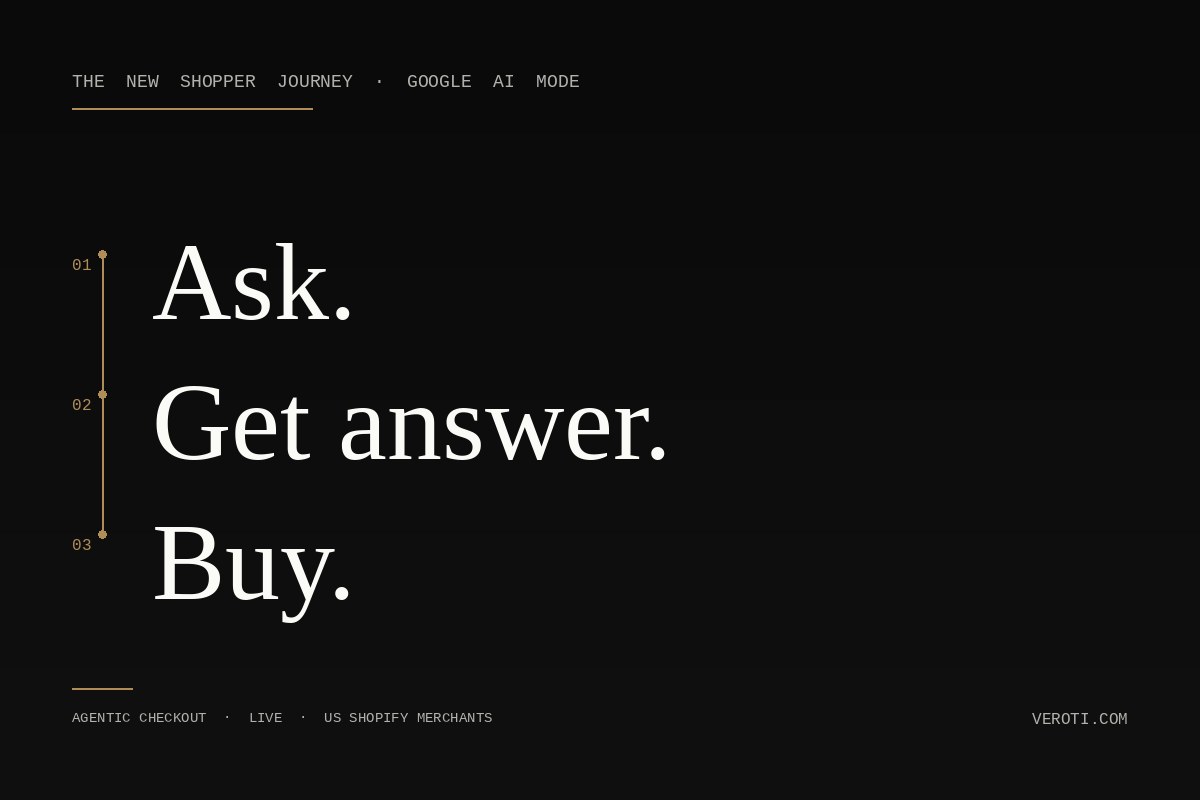
The new journey is: ask → get answer → buy.
There is no browsing step. There is no comparison step. The AI has done both of those before the shopper sees an answer. Your store doesn’t get a chance to convert a visitor anymore — because the visitor is no longer arriving on your store. The AI is reading your data, comparing you against alternatives, and making the recommendation. Then, in the agentic case, completing the purchase.
If your store is built for the old journey — a beautiful PDP, a clever cross-sell, a discount popup — none of that matters in the new one. The AI never saw the PDP. It saw your structured data.
The question worth asking now is whether your store is built for shoppers who don’t browse anymore. They just get an answer.
The 90-day playbook
If you operate a Shopify or Shopify Plus store and you want to be in the recommendation set when this matters in your category, the next 90 days look like this:
- Audit your Product Intelligence Layer. Inventory where each product attribute actually lives. If the answer is “in the description, sometimes” or “in App X for some products and App Y for others,” you don’t have a Product Intelligence Layer. You have a catalog with drift.
- Unify on Shopify metafields and metaobjects. Make Shopify the single source of truth. Every downstream surface — feed, schema, search index, subscription app — reads from it.
- Validate your structured data. Run every PDP through Google’s Rich Results Test. Confirm Product, Offer, AggregateRating, and FAQ are present, complete, and consistent with what the visible page actually says.
- Validate your feed. Pull your Merchant Center feed and compare line-by-line to your PDP. If the feed and the PDP describe different products, the AI is going to surface inconsistency and discount your signal.
- Make paid presence non-negotiable. Even a modest Performance Max budget keeps you on the canvas the AI is reading from. The cost of not being there is asymmetric — far higher than the cost of being there at a small spend.
- Set up brand monitoring inside AI surfaces. Ask ChatGPT, Claude, Perplexity, and Google AI Mode the buying questions your customers ask. Are you in the recommendation set? If you are not, that gap is your roadmap.
The system is live. The window is open.
Agentic checkout is expanding. Categories are coming online every month. The brands that get their Product Intelligence Layer right early will be in the recommendation set when their category goes live. The ones that don’t will be diagnosing flat numbers and tuning ad campaigns that can’t fix a data problem.
Most Shopify brands don’t have a data problem they recognize as a data problem. They have a data problem disguised as a performance problem. Closing the gap is structural work, not a campaign tweak. (For the architectural side of this — how the five layers actually fit together — see there is no app that makes your Shopify store agentic-ready.)
If you want a second opinion on where your store sits today — Product Intelligence Layer, schema, feed alignment, AI surface presence — get in touch. The audit is fixed-scope and the findings ship with code or configuration remediation, not just a slide deck.