
I’ve looked. It doesn’t exist. I know because I’ve built every one of these layers for real catalogs. Some took weeks. Some are still being maintained two years later.
What exists instead is a long chain of decisions that have to be made in the right order, by someone who understands how each layer talks to the next.
If a vendor pitches you a single app or a single dashboard that “makes your store AI-ready,” they’re either misunderstanding the problem or misrepresenting their product. Often both.
Why this is an architecture problem, not a plugin problem
A plugin solves a contained problem — one input, one output, one place in your stack. Agentic-readiness isn’t contained. It’s the sum of how five different systems interpret the same product, in the same moment, when an AI asks a question on behalf of a buyer.
If any one of those systems is out of sync with the others, the AI gets a contradictory signal. Contradictory signals lose to confident ones. There is no plugin that can resolve a contradiction between your feed, your schema, your app databases, and your storefront copy — because the contradiction is in the architecture, not in any single layer.
The brands that get this right early won’t just rank better. They’ll be the ones AI systems recommend when their competitors aren’t even visible.
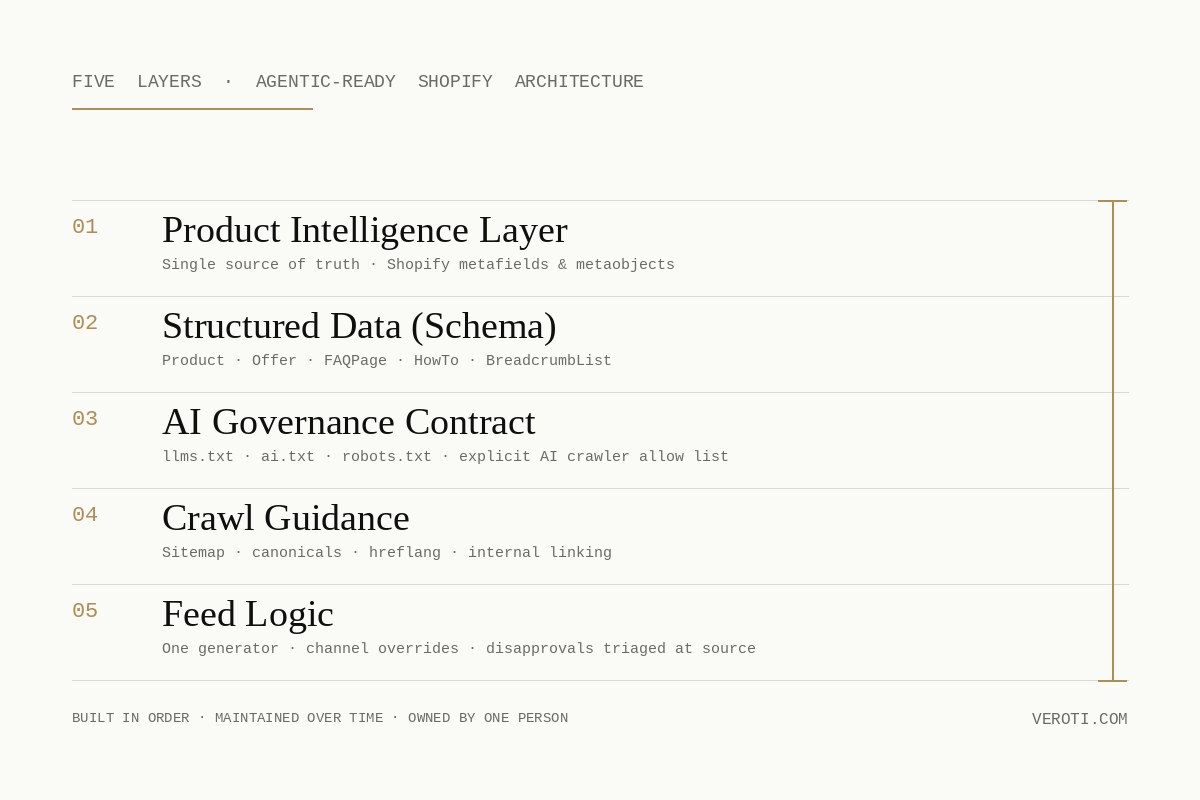
Here are the five layers, in the order they have to be built.
Layer 1 — Product Intelligence Layer
This is the single source of truth for everything your catalog knows about itself.
Not fragmented across description copy, variant titles, app databases, and manually written fields. One structured metafield and metaobject system inside Shopify, and every downstream system reads from it.
What this looks like in practice:
- Every product attribute that matters — material, dimensions, compatibility, fitment, ingredients, certifications, sizing logic — lives in a defined metafield or metaobject.
- The metafield definitions are documented. Anyone on your team can look up what
compatible_withmeans and what values are valid. - The Shopify Standard Product Taxonomy and the relevant Google product category are mapped on every product.
- The structure scales when you add a new product line. You’re not creating a new attribute pattern every time merchandising thinks of one.
If you cannot answer the question “where is the canonical attribute X for SKU Y?” with a single, unambiguous location, you do not yet have a Product Intelligence Layer. You have inputs to one.
Layer 2 — Structured data (schema), built correctly
Schema is the layer that translates your Product Intelligence Layer into a format Google and AI systems can read directly off your storefront.
Most Shopify themes ship with basic Product schema. That is not enough.
A complete schema layer for an agentic-ready store includes:
- Product — with
name,description,image,brand,sku,gtinwhere applicable,category, and links to Offer. - Offer (or AggregateOffer for variant ranges) — with
price,priceCurrency,availability,itemCondition,shippingDetails, andhasMerchantReturnPolicy. - AggregateRating and Review — pulled from your reviews app and emitted on the PDP, matching what visitors actually see.
- FAQPage — for PDP FAQs that answer the real questions buyers and AIs ask: compatibility, sizing, returns, warranty.
- HowTo — where applicable (assembly, installation, configuration), so AI assistants can confidently answer “how do I…” questions and recommend your product as part of the answer.
- BreadcrumbList — explicit hierarchy so the AI understands where this product sits in your catalog.
Each piece has to match what the visible page actually says. If the schema claims a 4.7 rating and the page shows 4.2, Google will discount the schema and your signal weakens. Consistency across visible content and structured data is non-negotiable.
Layer 3 — AI governance contract
A file at your domain that controls what language models are allowed to access, cite, and recommend about your brand. Machines need a policy document, not just humans.
In practice this means:
/llms.txt— a structured index, per the emerging spec, that tells AI assistants what your brand is, what you offer, and where to find authoritative content./llms-full.txt— a deeper brief for assistants that need more grounding before making a recommendation./ai.txt— explicit posture on training, inference, retrieval, search, and citation. If you want to be quoted, say so.- An updated
/robots.txt— explicit allow rules for the AI crawlers you want to be visible to: GPTBot, ChatGPT-User, OAI-SearchBot, ClaudeBot, anthropic-ai, PerplexityBot, Google-Extended, Applebot-Extended, Meta-ExternalAgent, and more. Default behavior is inconsistent across crawlers; an explicit allow removes ambiguity.
Without this layer, AI systems are guessing at how to talk about you — or worse, declining to mention you at all because your posture is unclear.
Layer 4 — Crawl guidance
AI indexers need to understand your site structure before they try to interpret individual pages. Otherwise they’re stitching together a model of your store from whatever pages happen to surface first — and getting it wrong.
The crawl-guidance layer includes:
- A clean, current
sitemap.xmlthat lists every URL you want surfaced and excludes the ones you don’t. - Canonical tags that resolve duplicate-content patterns (the
/products/…vs./collections/…/products/…issue on Shopify) so the AI doesn’t see two versions of the same product. - Pagination and faceted-navigation rules that don’t generate infinite junk URLs and bury your real pages.
hreflangannotations for international stores so the AI surfaces the right market’s variant.- Internal linking that mirrors how a human would navigate your catalog, so the AI’s mental model of your site matches reality.
Crawl guidance is unglamorous and easy to deprioritize. Skipping it means the upstream layers (Product Intelligence Layer, schema, governance) are doing their work on a foundation the AI never fully indexed.
Layer 5 — Feed logic
Your channel feeds — Google Merchant Center, Microsoft, Meta, Pinterest, TikTok Shop, marketplaces — have to pull directly from the Product Intelligence Layer.
This is the layer that breaks most often, because most merchants treat the feed as a separate artifact. They edit feed-specific overrides in a third-party app. They map categories manually inside Merchant Center. They tweak titles for “feed performance.” Over a year, the feed drifts away from the source of truth.
When an AI compares your feed entry to your PDP and they describe slightly different products, your signal weakens. Both surfaces lose confidence in you.
The discipline:
- One feed generator, reading from the Product Intelligence Layer, producing feeds for every channel.
- Overrides for channel-specific requirements (Google product category, GTIN format, image aspect ratio) handled inside the generator — not by hand in each channel’s interface.
- Feed disapprovals triaged at the source. If Merchant Center disapproves a product for “missing GTIN,” fix the metafield. Don’t suppress the warning.
Shopify Agentic Storefronts is the pipe, not the signal
Shopify has launched Agentic Storefronts, and it is a real step forward. It exposes whatever product data you already have to AI shopping agents through a defined interface.
But it is the pipe, not the signal.
If your data is incomplete, inconsistent, or unstructured, that is exactly what gets surfaced through the pipe. Agentic Storefronts doesn’t repair your catalog; it carries it.
It also doesn’t reach Google AI Mode, ChatGPT, Claude, Perplexity, or the other AI surfaces your buyers are already using to decide what to buy. Those systems read the open web — your schema, your llms.txt, your feeds — not Shopify’s proprietary pipe. (For the Google AI Mode side of this picture, see Google just changed how online shopping works.)
Treat Agentic Storefronts as one channel among several. Build the five layers above, and the channel becomes a beneficiary of the work. Skip the layers, and the channel becomes another place your store underperforms.
None of these layers know about each other by default
This is the part that gets lost in vendor pitches.
A schema app doesn’t know what’s in your metafields. A feed app doesn’t know what’s in your schema. Your reviews app doesn’t know what your structured data says about rating count. Your subscription app doesn’t know what the canonical product taxonomy is. Your llms.txt doesn’t update itself when you publish a new article.
You have to build the contracts between them. And then you have to maintain those contracts when platforms change, apps conflict, and your catalog grows.
That work is owned by an engineer or a technically literate operator who can hold the whole picture in their head. It is not owned by a marketing manager picking apps in the Shopify App Store. The two roles are not interchangeable.
Sequence and ownership
In the order they have to be built:
- Product Intelligence Layer — without it, every layer downstream is rebuilding on sand.
- Schema — translates the Intelligence Layer into what the open web reads.
- AI governance contract — tells AI systems how to treat your brand.
- Crawl guidance — ensures the AI actually finds and indexes the work above.
- Feed logic — extends the same source of truth into paid and channel surfaces.
Ownership has to be unified. One person — fractional, in-house, or advisor — holds the architecture in mind and signs off on every change. The moment two people are independently editing two of these five layers, drift is guaranteed.
What to ask your team this week
Three questions reveal where your store actually stands:
- “If I change the material of SKU 12345 in one place, does it propagate everywhere — PDP, schema, feed, search index, subscription app — without any other manual edit?” If the answer is no, you don’t have a Product Intelligence Layer yet.
- “Does our schema match what the page visibly says, on every PDP, today?” If nobody can confirm yes, the schema layer isn’t being maintained.
- “Which AI crawlers are explicitly allowed in our
robots.txt, and do we publish anllms.txt?” If the answer is “we haven’t looked,” the AI governance layer isn’t there.
If you get three “no” answers, you are not agentic-ready — and no app is going to make you ready. The work is real engineering. It pays off for years. And it is the difference between being in the AI recommendation set and being a brand the AI doesn’t know how to talk about.
What layer is yours missing? If you want a fixed-scope audit of where each of the five layers stands today, get in touch.