
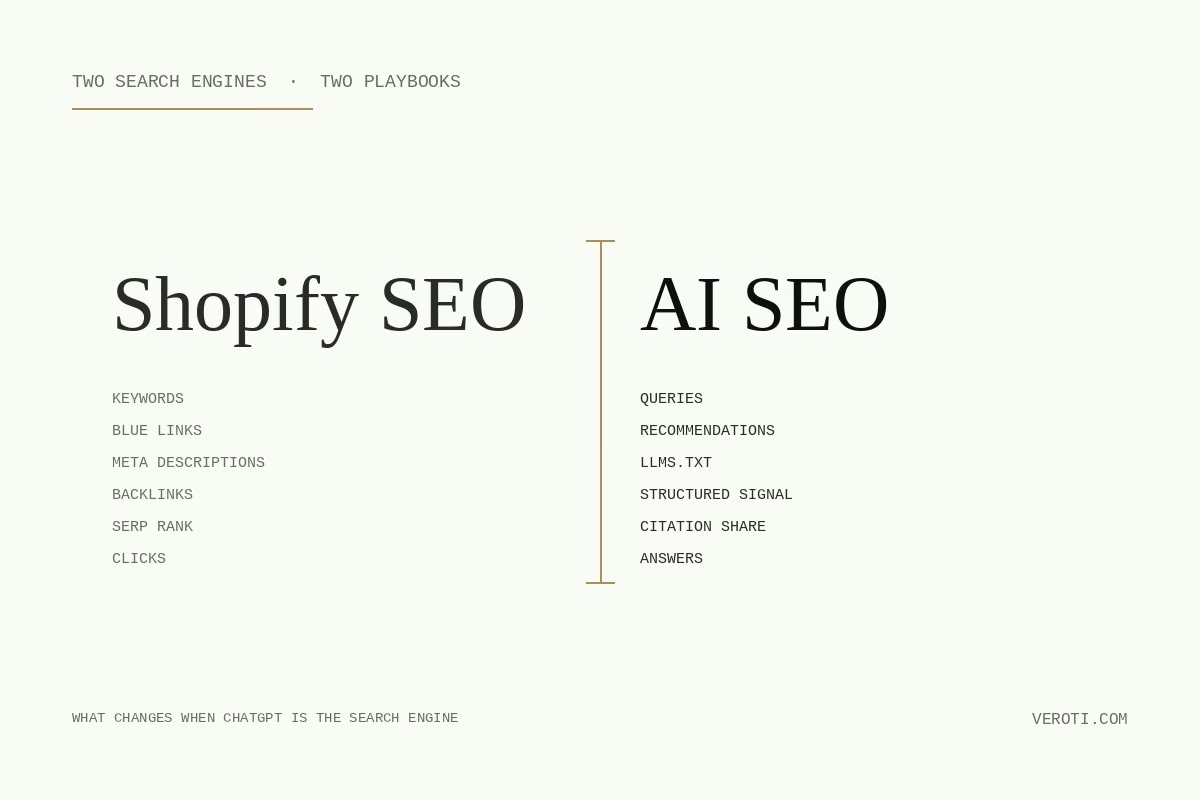
Most Shopify SEO playbooks were written for a world where shoppers typed keywords into Google and clicked blue links.
That world is shrinking faster than most ecommerce teams have absorbed.
Roughly 58% of shoppers now ask generative AI for product recommendations instead of going straight to a search engine. ChatGPT has hundreds of millions of weekly users. Google AI Mode is rolling out across categories. Perplexity is making real shopping queries. Claude is being asked “what should I buy.”
The work that gets a Shopify store recommended in those answers is not the same as the work that ranked it on page one of Google. Some of the muscle transfers. Some of it actively gets in the way.
This piece covers what AI SEO actually is, how it differs from Shopify SEO, what stays the same, and a free diagnostic you can run in fifteen minutes today to see where your store stands.
What Shopify SEO is
Shopify SEO is traditional search engine optimization tuned to the platform: collection-page strategy, product taxonomy, metafield-driven content, faceted-navigation handling, hreflang for Shopify Markets, canonical tags that resolve the /products/ vs /collections/…/products/ duplication, structured data implementation, and the long tail of technical optimizations that Shopify’s default theme behavior doesn’t get right.
The goal is to rank pages in Google search. The KPIs are usually clicks, sessions, and revenue attributed to organic.
What AI SEO is
AI SEO is the optimization of a brand’s signals so that generative AI assistants (ChatGPT, Claude, Perplexity, Google AI Mode) include the brand in their recommendation set when shoppers ask buying questions.
It’s sometimes called Generative Engine Optimization (GEO), Answer Engine Optimization (AEO), or LLM SEO, depending on which corner of the industry is naming it. They’re all the same broad practice: getting AI surfaces to confidently mention your brand when it’s relevant.
The goal is to be in the answer when the assistant gives one. The KPI is recommendation share across the AI surfaces buyers are actually using.
The fundamental difference
Shopify SEO assumes a shopper will see a list of stores and decide.
AI SEO assumes an AI will see a list of stores, will already have decided, and will tell the shopper which one (or two, or three) to consider.
That changes what matters in the work.
In the old model, the AI’s job didn’t exist. You optimized for human attention: write copy that earns the click, structure pages that keep the visitor, build links that earn ranking. In the new model, the AI is reading your page before any human sees it, comparing your machine-readable signals to your competitors’, and recommending whichever store gives it the most confident answer to give back.
A human shopper can forgive a thin spec sheet if the photography sells the product. An AI assistant cannot. The photography is invisible to it. The spec sheet IS the product.
What changes, side by side
The specific shifts when you move from optimizing for blue links to optimizing for AI recommendation.
Keywords become queries
Shopify SEO assumed shoppers searched with three-word phrases (“running shoes women size 8”). AI SEO assumes shoppers ask full questions (“what’s a good lightweight running shoe for marathon training that runs true to size for a women’s 8”). Your content and structured data need to answer the question, not just match the keyword.
Page rank becomes grounding citation
You used to fight for position one on a SERP. Now you fight to be the source an AI assistant cites in its answer. The mechanics are different. Backlinks help less. Structured authority (clean schema, defensible policies, real reviews emitted as AggregateRating) helps more.
Meta description becomes machine-readable summary
Your meta description was the snippet Google might show under your blue link. Mostly a copywriting exercise. The equivalent for AI SEO is your llms.txt blockquote, your Open Graph description, and the first paragraph of your product description, working in concert. Each should make sense in isolation, restate what the page is, and survive paraphrase. (For the file specifically, see llms.txt for Shopify Plus: what to include and what to block.)
Backlinks become structured signal
Backlinks were the original vote of confidence for Google. AI assistants weight them less. They weight structured signal heavily: schema that matches what the page says, policies that match the schema, feeds that match the policies, llms.txt that points at the canonical authority pages. Consistency across machine-readable surfaces beats inbound link volume.
Content for humans becomes content for retrieval
Long blog posts written for engagement still help, but the structure matters more than the prose. AI assistants quote sentences that read like answers. They skip paragraphs that read like marketing. Lead each section with the answer. Save the narrative for the body.
Collection pages, the Shopify-specific trap
Shopify SEO playbooks pushed teams to create thin collection pages for every long-tail variant (“blue running shoes”, “blue running shoes size 8”, “blue running shoes size 8 women’s wide”). It worked when Google’s algorithm rewarded specificity. It hurts AI SEO directly. AI assistants treat near-duplicate, thinly justified pages as noise and discount your whole catalog’s confidence score because of them. The fix is consolidation: one canonical collection page per real category, with structured filtering on top.
Variant URLs and faceted navigation
For Shopify SEO, indexable faceted navigation was sometimes a tactic (?color=blue&size=8 as crawlable URLs). For AI SEO it’s almost always a liability. The AI sees infinite variants of the same product and can’t tell what your canonical offering actually is.
What stays the same
The work that mattered in Shopify SEO still matters in AI SEO, just differently weighted:
- Site speed. Page Speed Insights numbers still matter. Crawlers (human and AI) skip slow sites.
- Mobile rendering. AI assistants fetch pages with mobile user agents. A broken mobile experience hides your content from them as effectively as it hides it from a human.
- Real product data. A complete title, accurate spec sheet, real photography. The fundamentals don’t change. The audience for them does.
- Real policies. Returns, shipping, sizing, warranty, written clearly and in machine-readable form. Both humans and AIs use them to qualify a purchase decision.
- Real reviews. Reviews matter more, not less. AI assistants emit
AggregateRatingfrom structured data when answering “is this brand reliable” questions. - No dark patterns. Tricks that worked briefly in 2018 SEO get penalized by AI assistants instantly. Hidden text, cloaking, doorway pages, scraped content. All worse for AI SEO than they ever were for Google.
The new game is more honest than the old one. AI assistants want consistent, machine-readable, truthful signals. Anything else gets discounted.
The one thing every Shopify owner can do today (free)
Fifteen minutes. Free. No tools required.
Pick one buying question your customers actually ask. Write it the way a real shopper would type it. Examples:
- “What’s a good Shopify brand for [your category] under $X”
- “Where should I buy [product] that ships to [country] with free returns”
- “What’s a more affordable alternative to [bigger competitor in your space] that’s still good quality”
- “Best [adjective] [your product type] for [use case]”
Now ask that exact question, with no modifications, to all four of:
- ChatGPT (chat.openai.com or the app)
- Claude (claude.ai or the app)
- Perplexity (perplexity.ai)
- Google AI Mode (the AI Mode tab in Google Search)
Write down which brands each one mentions. Are you in any of the four answers? In all of them? In none of them?
That list is your AI SEO roadmap.
If you’re in none of them, the gap between your current signals and what those assistants need to recommend you is the work. If you’re in some but not others, the variance tells you which surface each AI is reading from and which signal of yours is weakest where. If you’re in all of them already, congratulations: you’re already doing better than most stores in your category and the work now is to compound the lead, not catch up.
What this exercise won’t tell you on its own
The diagnostic is real. The fix is not.
This exercise tells you whether the AI surfaces currently recommend you. It doesn’t tell you why they don’t, where the structural gap is, or in what order to fix it.
Fixing it usually touches all five layers of the AI SEO infrastructure stack: the Product Intelligence Layer in your Shopify metafields, your structured data (Product, Offer, FAQPage, BreadcrumbList, HowTo, AggregateRating), your AI policy contract (llms.txt, ai.txt, robots.txt allow list), your crawl guidance (sitemap, canonicals, hreflang), and your feed logic (Merchant Center, channel feeds). When the AI doesn’t recommend you, one of those is usually leaking. Often more than one.
For the full architectural definition with what each layer does for AI surfaces and a free five-question diagnostic, see Generative Engine Optimization for Shopify: the five-layer stack. For the specific work on the AI policy file, see llms.txt for Shopify Plus: what to include and what to block. For the broader “no plugin solves this” argument, see there is no app that makes your Shopify store agentic-ready. For the larger context on what Google specifically is doing to ecommerce search, see Google just changed how online shopping works.
Should I stop doing Shopify SEO?
No.
The two practices overlap heavily and they reinforce each other when done together. Clean product data helps you rank in Google AND helps you get cited by ChatGPT. Real schema helps your blue-link visibility AND your AI recommendation share. Fast sites win both audiences.
What you should stop doing is the Shopify SEO that was only ever about Google’s blue links: thin doorway collections, keyword-stuffed product descriptions, faceted-nav landing pages with no editorial value, content written for keyword density instead of clarity. Those hurt your AI SEO directly. They’re also hurting your Google SEO now that Google’s own AI surfaces are eating the SERP.
The work that compounds for both is the same: clean data, real reviews, defensible policies, fast pages, machine-readable consistency. That’s the work that moves both numbers.
FAQ
Is AI SEO the same as GEO?
They overlap heavily. Generative Engine Optimization (GEO) is the term most current consultants and tooling vendors use. Answer Engine Optimization (AEO) is a sibling term. AI SEO is the broader, plainer-language version. They all describe the same practice.
Does Shopify SEO still matter in 2026?
Yes. Google blue links still drive real traffic. The mix is shifting toward AI surfaces, but both still matter. The work that compounds for both is the same.
Will Google AI Mode kill SEO?
It changes SEO, not kills it. The work that goes into “rank for X keyword” becomes the work that goes into “be cited when an AI gets asked X question.” The skill set transfers. Some specific tactics don’t.
How do I track AI SEO performance?
Manually, for now. Tooling is catching up but it’s early. The diagnostic above is the baseline: ask the buying questions, log which AI surfaces mention you, track the trend monthly. Once that gives you a baseline, you can prioritize structural fixes.
Is AI SEO faster or slower than Shopify SEO?
Different timeline shape. Shopify SEO compounds slowly over months as Google re-crawls. AI SEO can show movement in days when you fix a structural signal. The hard part is not waiting. It’s diagnosing which layer to fix first.
Does AI SEO work for Shopify specifically?
Yes. Shopify’s structured-data baseline is decent (better than WooCommerce or BigCommerce). Metafields give a clean place to host the Product Intelligence Layer. Theme blocks let you emit clean JSON-LD without app sprawl. The platform is well positioned. Most Shopify stores just haven’t done the work.
Should I hire someone for AI SEO or do it in-house?
Depends on whether the underlying architecture is in place. If your metafields are clean, your structured data is current, and your feed is healthy, AI SEO is largely an extension of work a good senior developer can steer with documentation. If those layers are leaking, AI SEO compounds the problem and an architect saves time and money.
The window
The Shopify-specific advantage worth knowing: the brands that get AI SEO right early in 2026 will be in the recommendation set when their category goes mainstream on AI surfaces. The brands that wait will be diagnosing flat numbers a year later and tuning ad campaigns that can’t fix a structural signal problem.
This is a window. It closes. The brands that closed the same gap on Google SEO in 2010 are still benefiting from that lead in 2026. The AI SEO window will close faster (probably within eighteen months) but the lead it produces will compound the same way.
If you want a structural read on whether your store is in the recommendation set today and where the layers are leaking, that’s what the audit covers.