
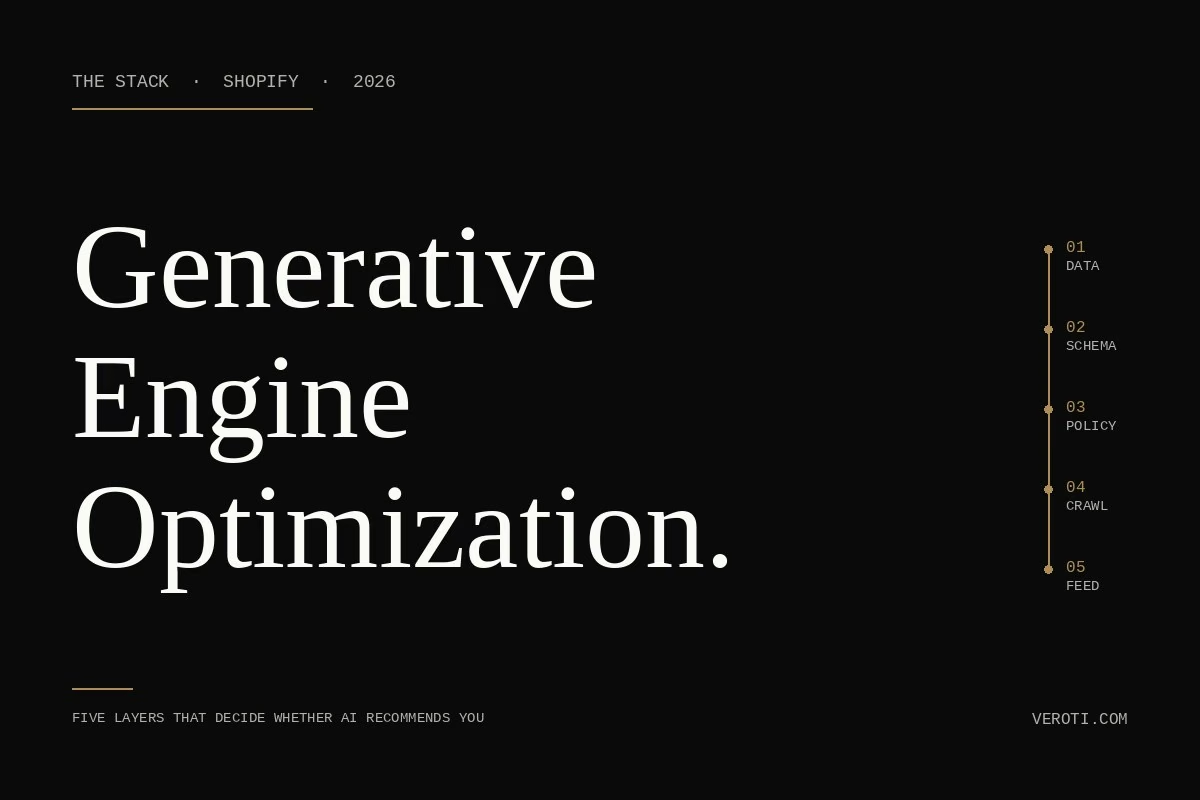
There’s no single thing you do to get cited by ChatGPT. There are five.
Generative Engine Optimization (GEO) is the work that decides whether AI assistants confidently recommend your Shopify store when shoppers ask buying questions. Not the work to rank in Google. Not the work to grow on social. The specific architectural work that puts you in the answer when ChatGPT, Claude, Perplexity, or Google AI Mode is the one being asked.
It is not a tactic. It is a stack.
This is the architectural definition for Shopify and Shopify Plus stores: what GEO actually is, the five layers in order, what each layer does for AI surfaces, why the order matters, and a free five-question diagnostic any owner can run today to see where their store stands.
What Generative Engine Optimization is
Generative Engine Optimization is the practice of optimizing a brand’s signals so that generative AI assistants include the brand in their recommendation set when shoppers ask buying questions. The shoppers used to type keywords into Google. They now type questions into ChatGPT, Claude, Perplexity, and Google AI Mode, and the AI gives them an answer with a small set of recommended brands inside it.
You want to be in that answer.
GEO has siblings. Answer Engine Optimization (AEO) is the same practice with a slightly different name. LLM SEO is the same practice for developer-leaning audiences. AI SEO is the broader, plainer-language version most people actually type into a search bar. They all describe the same broad work. (For the contrast with traditional SEO specifically, see AI SEO vs Shopify SEO: what changes when ChatGPT is the search engine.)
For Shopify and Shopify Plus stores, GEO is not a single thing you install. It is a five-layer architectural stack that has to be built in order and maintained over time. Each layer matters. Each layer reinforces the others. A weak layer drags down the strong ones because AI assistants evaluate consistency across machine-readable surfaces, not the strength of any one of them in isolation.
Why a stack and not a checklist
The single biggest mistake in early GEO advice is treating it as a checklist of tactics.
“Publish an llms.txt.” “Add Product schema.” “Get into Merchant Center.” All are necessary. None are sufficient. When AI assistants ground a response on your store, they read multiple signals simultaneously and form a confidence score based on whether the signals agree. If your llms.txt says you sell premium handmade ceramics, your schema says “Home & Garden > Tableware”, your Merchant Center feed says “Kitchen accessories”, and your storefront copy says “artisan dinnerware,” the AI doesn’t pick the most flattering version. It discounts all of them.
Consistency across the five layers beats heroics in any single layer. The brands that get cited by AI surfaces are not the ones with the cleverest schema. They’re the ones whose schema, feed, llms.txt, and storefront all describe the same brand selling the same products to the same customers.
Here are the five layers, in the order they have to be built.
Layer 1 — Product Intelligence Layer
The single source of truth for everything your catalog knows about itself. Hosted in Shopify metafields and metaobjects. Every downstream system reads from it.
What it does for GEO: Gives AI assistants a confident, structured map of your products. Every attribute that matters (material, dimensions, compatibility, fitment, ingredients, certifications, sizing logic) lives in one defined place. When ChatGPT asks itself “what is this product, exactly,” the answer comes from a single canonical record, not from inferring across description copy, variant titles, and three different apps.
What good looks like: Every product attribute is in a documented metafield or metaobject. The Shopify Standard Product Taxonomy is mapped on every product. The Google product category is mapped. Anyone on your team can answer “where is attribute X for SKU Y” with a single, unambiguous location.
Common failure mode: “Most of it is in the description, some of it is in App A, some is in the variant title, the spec sheet is in a PDF, we’ll get to it.” That is a catalog with drift, not a Product Intelligence Layer. Every downstream system is then describing slightly different products, and the AI sees the inconsistency before it sees anything else.
Layer 2 — Structured data
JSON-LD that translates the Product Intelligence Layer into a format the open web (and every AI assistant grounding on it) can read directly from your pages.
What it does for GEO: Gives AI assistants the structured equivalent of your product. Schema is what an LLM quotes when asked specifics: “is this product in stock,” “what’s the rating,” “what’s the warranty,” “does it ship to Canada.” The answers come from Offer, AggregateRating, Product, FAQPage, and shippingDetails in your JSON-LD, not from the AI parsing your visible copy.
What good looks like: Every PDP emits Product with name, description, image, brand, sku, gtin where applicable, and links to Offer with price, priceCurrency, availability, itemCondition, shippingDetails, and hasMerchantReturnPolicy. Reviews emit AggregateRating and Review matching what the visible page says. PDP FAQs emit FAQPage. Where applicable, HowTo for assembly or configuration. BreadcrumbList for hierarchy. Every value matches what the visible page actually displays.
Common failure mode: Schema that contradicts the visible page. Your JSON-LD says 4.7 stars; the page widget shows 4.2. Your schema says “InStock”; the page says “backorder.” The AI catches the contradiction and discounts the schema entirely. Consistency is non-negotiable.
Layer 3 — AI governance contract
The set of files at your domain root that tell AI assistants what your brand is, what they can do with your content, and where to find the canonical content.
What it does for GEO: Hands the AI a structured introduction to your brand and an explicit permissions posture. Without it, the AI guesses from meta tags, third-party mentions, and your visible copy. The guess is rarely as flattering as what you’d write.
What good looks like: A working /llms.txt that overrides Shopify’s minimal default with your real positioning, your authoritative content, and your Plus-specific structure (Markets regions, B2B portal, subscription terms). A /llms-full.txt companion with deeper context. An /ai.txt stating your training and citation posture. A /robots.txt with an explicit allow list for the AI crawlers you want to be visible to. (For the full anatomy and how to override Shopify’s default at the edge, see llms.txt for Shopify Plus: what to include and what to block.)
Common failure mode: Letting Shopify’s auto-generated llms.txt stand as the default. It’s generic, intentionally minimal, and indistinguishable from every other store in your category that also did nothing.
Layer 4 — Crawl guidance
The structural directives that tell AI indexers how to navigate your store before they try to interpret individual pages.
What it does for GEO: Gives the AI a coherent mental model of your catalog. Without crawl guidance, AI indexers stitch together a view of your store from whatever pages happen to surface first, and they get it wrong. With it, they see the canonical pages, in the canonical hierarchy, in the right markets.
What good looks like: A clean, current sitemap.xml that lists every URL you want surfaced and excludes the rest. Canonical tags that resolve Shopify’s /products/… vs /collections/…/products/… duplication. Pagination and faceted-navigation rules that don’t generate infinite junk URLs. hreflang for international Markets. Internal linking that mirrors how a human would navigate the catalog so the AI’s mental model matches reality.
Common failure mode: Crawlable faceted navigation URLs (?color=blue&size=8) that look like real pages to the AI but are near-duplicates of canonical product pages. The AI sees infinite variants of the same product and can’t tell what your canonical offering actually is.
Layer 5 — Feed logic
The channel feeds (Google Merchant Center, Microsoft, Meta, Pinterest, TikTok Shop, marketplaces) that put your products into the commerce graphs AI shopping surfaces actually read.
What it does for GEO: Extends your Product Intelligence Layer into paid and channel surfaces. AI shopping surfaces (especially Google AI Mode) fetch product data from feeds for commerce queries. If your feed is wrong, your PDP being right doesn’t matter for those queries.
What good looks like: One feed generator, reading from the Product Intelligence Layer, producing feeds for every channel. Channel-specific overrides (Google product category, GTIN format, image aspect ratio) handled inside the generator, not by hand in each channel’s interface. Feed disapprovals triaged at the source: if Merchant Center disapproves a product for “missing GTIN,” fix the metafield. Don’t suppress the warning.
Common failure mode: Feed-specific overrides edited directly in a third-party feed app. The feed drifts away from the source of truth over months. When an AI assistant compares your feed entry to your PDP, the descriptions differ slightly, and your signal weakens across both surfaces.
Why the order matters
The five layers are not independent. Layer 1 has to be solid before layer 2 means anything, because schema reading from drift is worse than no schema. Layer 5 depends on layer 1, because a feed pulling from a messy catalog amplifies the mess across every channel. Layer 3 is the most visible and the easiest to ship, which is why so many GEO articles start there, but in isolation it produces diminishing returns. A clean llms.txt sitting on top of inconsistent layers underneath is a polished surface on a leaking foundation.
In the order they have to be built:
- Product Intelligence Layer. Without it, every downstream layer is building on sand.
- Structured data. Translates the Intelligence Layer into what the open web reads.
- AI governance contract. Tells AI systems how to treat your brand and where the authoritative content lives.
- Crawl guidance. Ensures AI indexers find and index the work above.
- Feed logic. Extends the same source of truth into paid and channel surfaces.
This is the same five-layer architecture I describe in there is no app that makes your Shopify store agentic-ready, viewed through the GEO category lens instead of the “no plugin will solve this” argument.
The five-question diagnostic (free)
The one thing every Shopify owner can do today. Five questions, one per layer. Answer honestly. Yes is one point.
- Layer 1. If you change a product attribute (material, weight, fitment) in one place, does the change propagate to your storefront, structured data, feed, on-site search, subscription app, and loyalty app without any other manual edit? Yes / no.
- Layer 2. Does every product detail page pass Google’s Rich Results Test for
ProductandOfferwith no errors or warnings, and do the schema values match exactly what the visible page shows? Yes / no. - Layer 3. Have you overridden Shopify’s auto-generated
llms.txtwith your own version, and do you also publish a working/ai.txtand an explicit AI crawler allow list inrobots.txt? Yes / no. - Layer 4. Does your
sitemap.xmlcontain only canonical URLs, do your canonical tags resolve Shopify’s product duplication patterns, and ishreflangcorrect on every Markets storefront? Yes / no. - Layer 5. Does your Merchant Center feed pull from your Product Intelligence Layer with zero hand-edited overrides, and do the feed and PDP describe the same product word-for-word? Yes / no.
Add the score. Out of five.
- 5 / 5. You’re ahead of most stores in your category. The work now is to compound the lead, not catch up. Monitoring becomes the next priority: are the AI surfaces actually citing you, and where is the lead widest or narrowest.
- 3 to 4 / 5. One or two layers are leaking. Identify which and fix in order (Layer 1 first if it’s on the list, then 2, then 3). Most stores land here.
- 1 to 2 / 5. The architecture is incomplete. The cheapest fix in isolation (usually layer 3) won’t produce the lift you expect because the foundation is missing. Layer 1 is the right starting point.
- 0 / 5. The store is operating on Shopify defaults across every layer. That’s a baseline, not a strategy. Every layer is opportunity.
This diagnostic doesn’t tell you how to fix the gaps. It tells you where you stand. The fix is the engagement.
What this self-assessment doesn’t fix
Knowing your score is diagnostic. Getting to five out of five is architectural.
Each layer touches multiple systems and the contracts between them are not documented anywhere generic. The metafield structure that supports the Product Intelligence Layer is brand-specific. The schema emitted from your theme depends on which theme and which apps. The override path for Shopify’s default llms.txt depends on whether your domain is fronted by Cloudflare, Vercel, Netlify, or something else. The feed generator you use depends on your channel mix and your data shape.
And the layers have to be maintained when Shopify changes platform defaults, when apps update and break compatibility, and when your catalog grows. GEO is not a project you ship. It’s an infrastructure layer you operate.
For the broader context on why this matters now (Google AI Mode going live, agentic checkout expanding, the shift in shopper behaviour), see Google just changed how online shopping works.
FAQ
What is Generative Engine Optimization (GEO)?
The practice of optimizing a brand’s signals so generative AI assistants (ChatGPT, Claude, Perplexity, Google AI Mode) include the brand in their recommendation set when shoppers ask buying questions. For Shopify it’s a five-layer stack: Product Intelligence Layer, structured data, AI governance contract, crawl guidance, feed logic.
How is GEO different from SEO?
SEO assumes a human will see a list of stores and decide. GEO assumes an AI will see the same list and decide on behalf of the shopper. Queries replace keywords, recommendation share replaces SERP rank, machine-readable summaries replace meta descriptions, structured authority replaces backlinks. The two practices overlap heavily and reinforce each other when done together.
Which layer should I fix first?
Always Layer 1, the Product Intelligence Layer. Every downstream layer reads from it. Without a clean source of truth, fixing layers two through five just propagates drift faster.
Does Shopify do any of this automatically?
Shopify ships a floor for some layers: auto-generated llms.txt and llms-full.txt, basic Product schema in modern themes, automatic canonical tags, and a default sitemap. The defaults are a floor, not a ceiling. The real work is overriding or extending each with your own opinionated implementation.
How long does it take to ship all five layers?
For a Shopify Plus store with a clean catalog, a basic version can be in production in four to six weeks. A thorough implementation runs eight to twelve weeks. Stores with messy underlying data spend most of the time in Layer 1.
Do I need all five layers or can I cherry-pick?
All five reinforce each other and any single layer in isolation produces diminishing returns. The most valuable single layer to fix is layer 1, because it pays off through every downstream system regardless of when those get tuned.
How do I know if the work is paying off?
Pick a buying question your customers ask. Ask it to ChatGPT, Claude, Perplexity, and Google AI Mode. Log which brands each one mentions. Track the trend monthly. (Full diagnostic in AI SEO vs Shopify SEO: what changes when ChatGPT is the search engine.)
The window
The brands that get the five-layer stack right in 2026 will be in the recommendation set when their category goes mainstream on AI surfaces. The brands that wait will be diagnosing flat numbers a year later and tuning ad campaigns that can’t fix a structural signal problem.
This is a window. It closes. The brands that closed the same gap on Google SEO in 2010 are still benefiting from that lead in 2026. The GEO window will close faster, probably within eighteen months, but the lead it produces will compound the same way.
If you scored under five and want a structural read on which layer is leaking and what the engagement looks like to fix it, that’s what the audit covers.